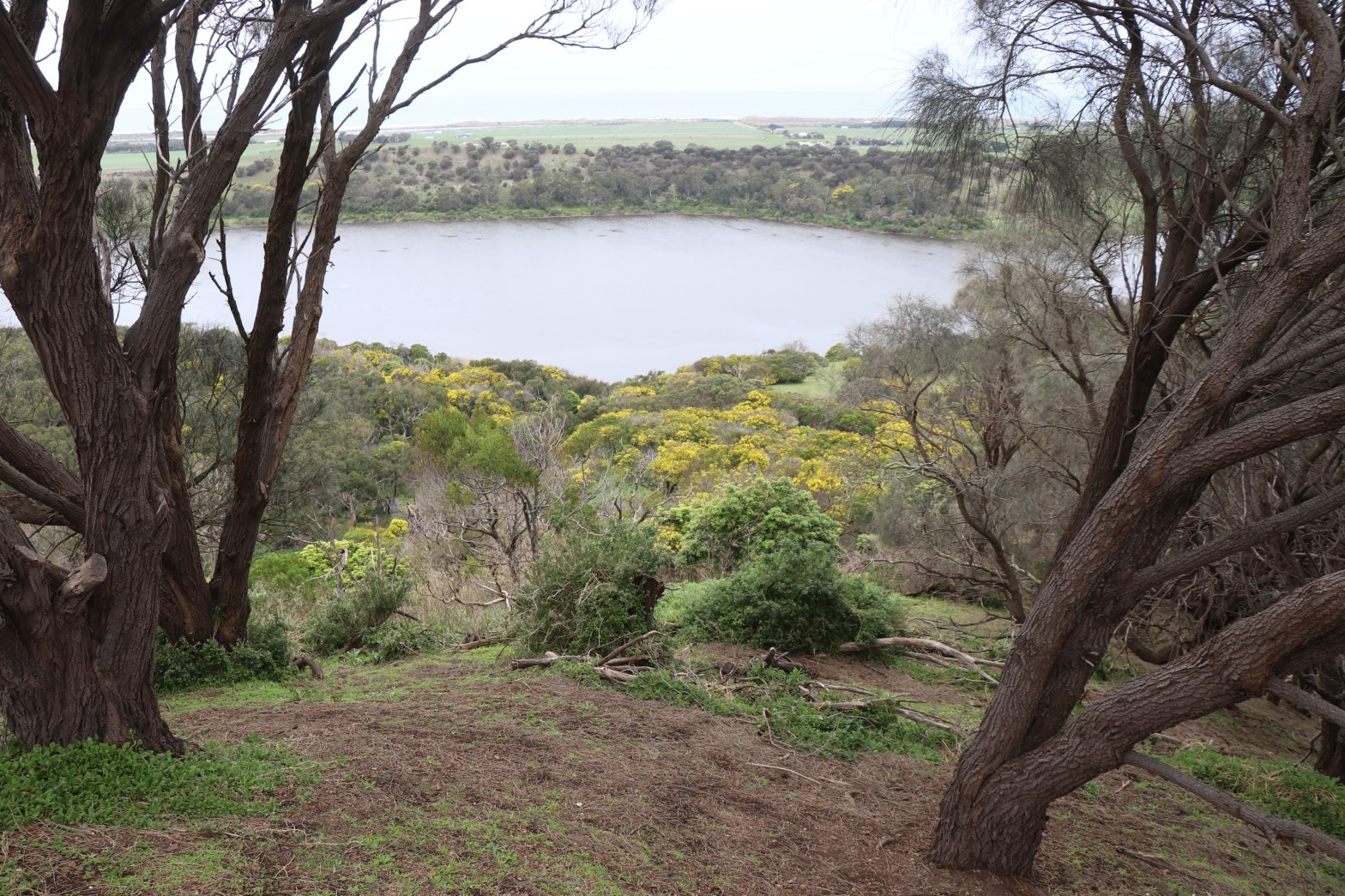
What – Tower Hill
Where – next door to Koroit in south west Victoria
How – just turn off Princes Highway. There are many different walking options.
10 words – living example of massive – destruction, reconstruction, art, dreaming, achieving, contrasts


I always feared Tower Hill.
Someone had crashed over the side in the early 1970s and I would plead with mum not to take the route along its edge on the way home from Warrnambool.
A year or two after, my older sisters were part of a mass regional effort to re-plant the extinct volcano with its original vegetation.
As a young journalist, I interviewed the bloke who drove the tractor to prepare the dirt for planting.
They were frightening recollections of working at precarious angles –probably with no roll bar – on the edge of that very steep and much-feared (by me) cliff.

He also told of his frustration at never managing to kill the last Tower Hill rabbit. Doubt he was alone there.
Today I happily return to this place of past childhood angst to check out some of Chris and Kate’s – and 1000s of other 1970s high school kids’ – handiwork.
On the the land of Gunditjmara peoples, Tower Hill is a dormant volcano which last erupted 35,000 years ago and represents one of the world’s few remaining nested Maar volcanoes.
Perched beside Australia’s Number One highway and surrounded by cleared, flat green paddocks – it is a hilly, bush oasis.

In 1855 early European settler James Dawson – who farmed on Kangatong near Hawkesdale and developed great friendships with the local first nations peoples – recognised its value as “one of the most beautiful and interesting specimens of extinct volcanoes in Victoria.”
He commissioned artist Eugene von Guerard to paint it, in what would be a big and valuable move, especially a century later.

In 1857 writer James Bonwick was calling for it be made an ‘everlasting reserve’. He raved about the leafy shrubs, trees that formed delightful bowers, gigantic ferns and almost tropical reeds.
This was about the same time the shallow swamp was dammed – stopping eels from entering the lake – to be followed by clearing, burning and grazing in the 1860s and 1870s.
When Dawson returned in 1891 his ‘beautiful lake’ was drained, quarried and overrun with thistles, boxweed and rabbits.
Charles Kingsford Smith flew a plane over it in 1932 and in the 1950s it was the scene of car racing and shooting.


That could have been the end of the story if Fisheries officer Max Downes had not begun a restoration project in 1960. Max happened up von Geurard’s painting with the original rendition of its tea trees, wattles, banksias and Eucalypts.
Using the painting as a guide, he and his team oversaw the volunteer planting of more than a quarter of a million trees and shrubs between 1964 and 1984.
Today I am doing two quick walks – in between the rain. The first is up to the highest peak which is not really that high but should be fun.


After all my obscure Wimmera reserves, it is weird following at track that is virtually concrete path all the way.
And there are many people about – a vast contrast to my often solo adventures.
The tracks are all well sign-posted too and there a heaps of big trees but the understorey does give clue to the century of neglect. So many weeds including stinging nettles and huge thistles, as well as blue forget-me-nots.


There are also a lot of dead trees – which might be something to do with one big plant-out over 20 years; resulting in many plants beginning to die at the same time four to five decades later.


It is still an amazing testament to human endeavour and organisation.
Half way up the hill I pass an old crater filled with trees but still showing some of the brilliant burnt orange volcanic soil.
The views on this walk are breath-taking – as is the climb up the long ramp – literally. At one point you can see the scarred wall where the quarry once was, contrasted with the lush brilliance of the flowering wattles.
Beyond this is a distant estuary tucked beside sand dunes and then open sea on the other side.


Then you turn your attentions north to lines of both big houses and neatly-planted pine trees assembled at the top of the cliff.

This is still a place of many contrasts.
Heading back, I can’t help but notice the weeds as well as a blue wren, wallaby and magpie that seem to pose for photographs – two sides to this recreated bush. The emus are also particularly friendly – and I have heard very keen to take whatever unsuspecting visitors wave in their path.


My second trek is a boardwalk around the lake area.
It is all just so lush. The lichen and mosses are abundant and the bright orange fungi just thriving this winter.


Tower Hill might be full of people but it so peaceful and I see what James Bonwick meant about the “leafy shrubs, trees that formed delightful bowers, gigantic ferns and almost tropical reeds” . I hear some emus but only get to see the backs of them running away.


As the rain intensifies and I get back to the car I give thanks to James, Euegene and later Max for their keen observations and vision in helping ensure that Tower Hill is still here and thriving – despite all that has been thrown at it over many years.


 52 weeks 52 walks

I really enjoyed reading about Tower Hill I have wondered about the history and we moved here 2 years ago and love it, more so seeing the animals come into our garden and help them self’s to the fruit off our trees ‘thank you’
LikeLike
My pleasure – feel free to join the facebook group 52walks52weeks – I do a lot in the Wimmera but get back to the southwest sometimes (when not in lockdown) – thanks for the feedback.
LikeLike